Eirinie Carson
California, USA
Writing
Artist in Residence, 2026
McLaughlin Foundation Award, 2026
↗ www.eiriniecarson.com
Artist Statement
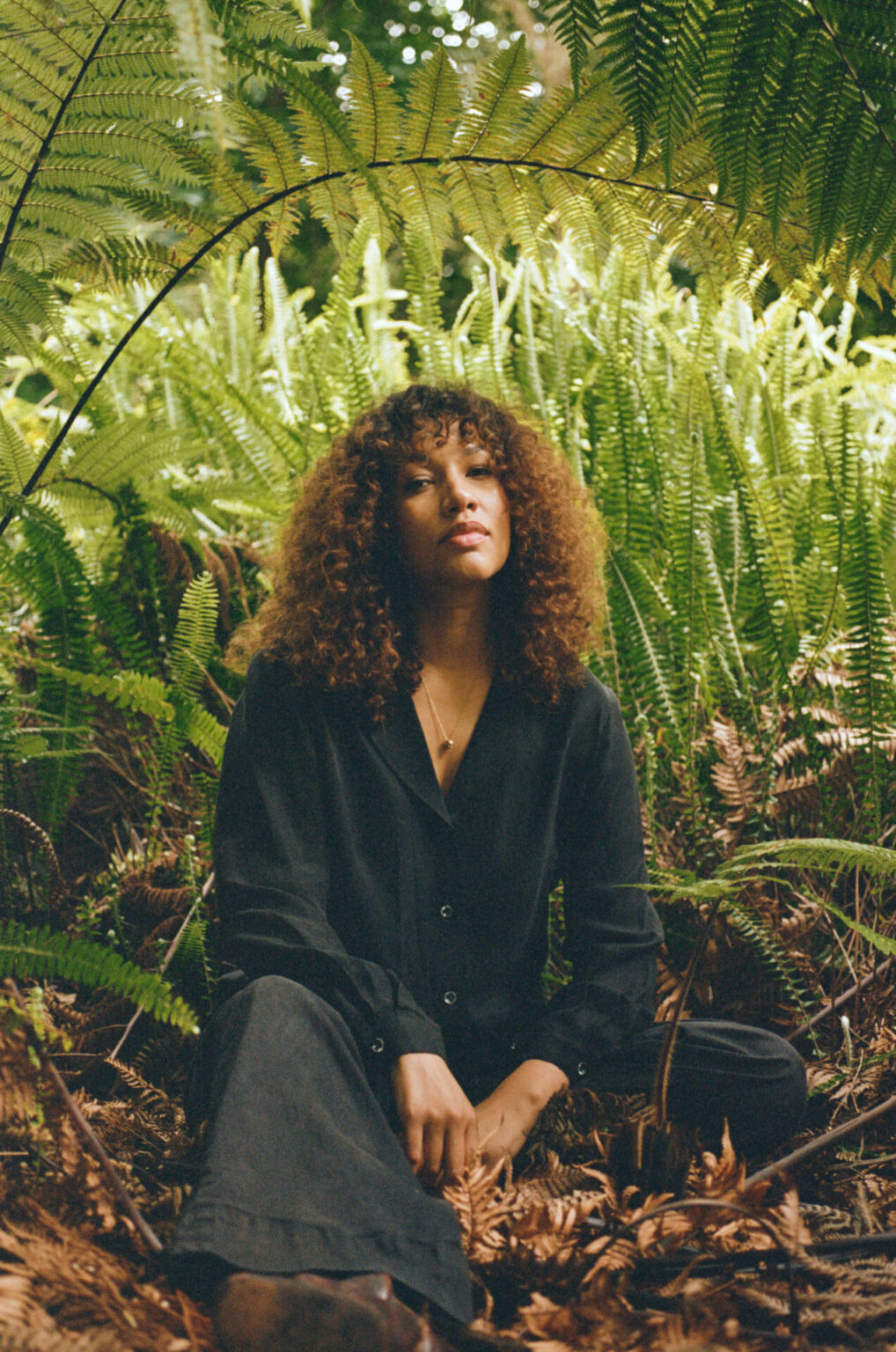
I am a Black British mother and author, living in California. My fiction primarily focuses on ancestral inheritance in a world desperate to sever the connections between what came before and what is to come. I write about the quiet suffocation of racism, poverty and food scarcity juxtaposed against the kind of casual wealth most people will never see, as well as the mundanity of sex work, and the notion that heritage is un-outrunable. My creative process is galvanized by my own life experience, including but not limited to family trauma, sexual assault, sex work, sexual taboos, illegal substances, hauntings both real and imagined, death and dying, and the celestial. I have written two books- a memoir entitled The Dead Are Gods, and a novel, Bloodfire, Baby.
While at Headlands
While at Headlands I will be focusing on my third book, a novel tentatively entitled One Last Thing, is based on my father’s early years as a Caribbean immigrant in 90s London. One Last Thing follows Denton, a heroin user, who must undertake an Odyssean journey across London to find his passport and return to Jamaica for his mother’s funeral. I see myself completing this manuscript at Headlands, as well as continuing a work-in-progress short story collection, Model Citizens. As a parent to young children, the gift of space and time will not be squandered, and I am looking forward to allowing myself to fully unfold as an artist.
Selected Work
This is how you close up a house for the season:
First you have to clean; there are dishes and forks and fly blown glasses from rum punch,
mosquitoes buzzing inside from carelessness with the screen door, ceiling fans left on barely making a dent in the thick late summer air, sheets stained and twisted on the floor like they tried to escape the confines of the bed, toilets stained with all manner of nastiness, items left behind like a gold watch, an earring, a woman’s bikini bottom hung out to dry on the back deck. All of it needs to be righted, all of it needs to be put back to its proper place. You put the sheets on to wash, and while they’re in there you sweep and mop and it is backbreaking work. Women’s work, or so they say, but backbreaking all the same. Get the corners, beneath the dressers, under the table where foreign food sits, coz these folks don’t eat what we give them, no, they ask for familiar things, beige and brown things. You can try to cook them some plantain, get them to taste something new, to see what your own tongue tries, but they will politely smile and the minute you leave and wipe your hands on your apron, “may I go now, missus?” and the minute you get picked up out front by your cousin they will scrape it into the bin furtively, but they won’t be kind enough to hide it so you’ll see it the next day, greying and wasted, dusted with coffee grounds.
You wipe the mirrors flecked with toothpaste, sometimes so much that you almost
imagine them leaning their heads back and spitting full force into the mirror hatefully. You clean remnants of hair out of the sink, you refill and replace hand soaps, shower gels, shampoos. You put the sheets into the dryer now, the whole thing easier than it would be at your house where you have no washer, no dryer. You wash your own sheets in the sink, you dry them out back on a line strung between the corner of the house and a tree, at an angle that gets the midday sun. Something meditative in hand washing things. Backbreaking too, of course, but a gentle slowness that you associate only with home.
The windows need washing, and by now it is early afternoon, the tourists are probably
back on a flight home, probably kicked their shoes off and thumbing through a magazine, a glass of chilled wine in hand, a fridge full of beige food awaiting them at home. You get a bucket of suds, you scrape and you wipe, its long work but by now you are quick with it, deft strokes get the panes clean fast, not a drop spilt. They aren’t paying you for two days work, so there’s no point in taking your time. Your hands are calloused, your skin dry around the knuckles although you grease them up every night.
You lay crisp, dry cotton sheets across beds bigger than the one you share with your
oldest daughter, tuck them well. You learned young how to make a bed straight, your own
mother never let you live it down if you were sloppy. Where did she learn all that bed making? Where did she get all that knowledge about how to clean, how to best move around the white folks you work for, eyes down, in the corners of the room like a shadow? How did she know that when the tourists come to this island they want to feel like bigmen, like bossmen, like missus and sir and don’t you remember how this began? Don’t you remember all the death and destruction, the punishments and the barely concealed hatred? It’s still all there, it’s still waiting in this island. They continued it, even though its illegal, even though they hate to talk about it, it continued as they bought up beach front properties, as they turned plantations into wedding venues, as they polluted the water and the trees, diverting resources for their own insatiable thirst. And we let them.
When everything is clean and renewed, when you have the 6 bags of trash on the front
porch that you yourself will take to the dump, bags behind you in the car like 6 sick, lumpy, dead eyed children, so you can smell the filth of them, you will be done. You will have an hour, maybe less, to spend alone in that house, and that is the main reason you work so fast. You make yourself a cup of tea (you’ll clean the cup up later), you sit out on the veranda where the pool meets the green hillside that cascades towards the ocean like a waterfall, you’ll sit in the swing bench and rock yourself and sip your tea, listening to the buzz of the insects, the breeze in the trees, all of Jamaica so beautiful from right here.
Birds clicking unseen, distant sounds of construction echoing up from the hotels at the
beach, the air warm so you can almost taste it, heavy and sweet on your tongue. The smell of sun heating the insides of leaves, toasting the vegetation, tree bark humming, the sun’s rays making everything feel like it’s vibrating. Electricity buzzing overhead, sounds of people calling to each other, food cooking over a camping stove, chargrilled fish undercut by the scent of kerosene.
You can’t see the ocean from your own house, the jungle dense up there, and you rarely
have the time to make it to the beach any more, when your children were small you did, but they’re older now, they make their own beach trips without you after school, uniforms rolled up their brown legs to feel the surf at their feet. They will feel the ocean, they will think, this island is mine, this ocean is mine, this sand is mine. And they’re right, in a way, but you’re a mother, you know the truth. You know the future. Some things are hard to clean.