Yulia Pinkusevich
california | visual
Graduate Fellowships Program 2012—2013
Artist Statement
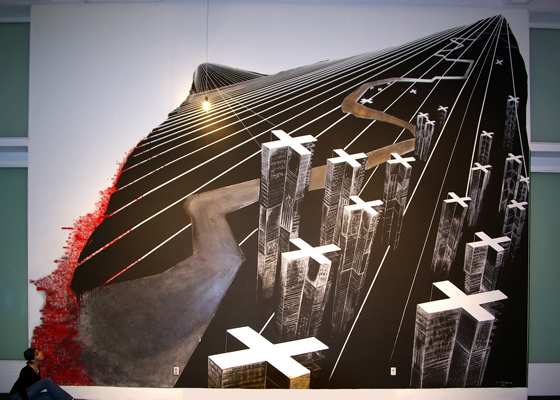
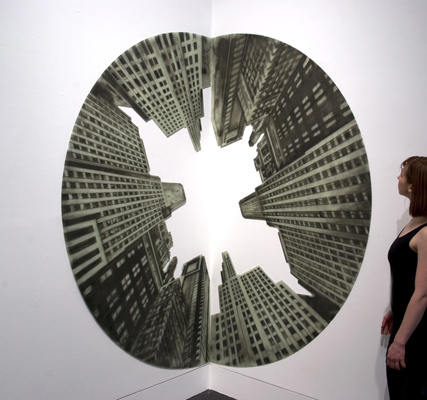
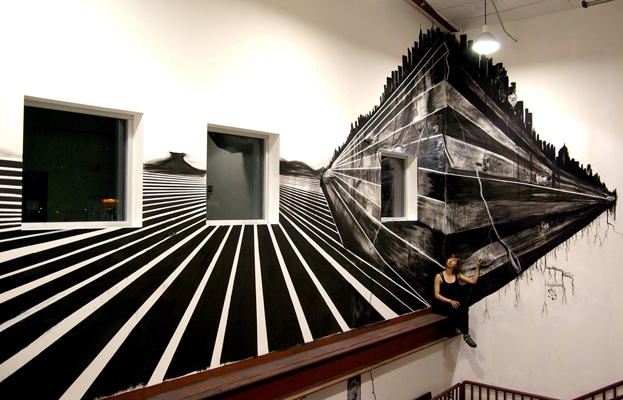
The rapid spread of urban life is now visible throughout the planet. In the last century the built environment has grown ever taller and denser. Daily life is now physically framed through an architectural lens. These architectural frames create a layered and multi-faceted vision of the world around us. Edges of buildings, voids, windows, doors, power-lines and car windshields provide this framing for us to look through. Architecture is experienced through a secondary frame of ever more architecture, creating a fragmented, multi-layered structural framework of cement steel and glass, a common vision for the urban citizen. As an artist, my work is concerned with this fragmented vision of architectural layering and perceptions of the built environment. Formally, the work is engaged with the direct experience of the viewer through perspectival illusion and spatial perception that play with the subconscious and cognitive understanding of space. By breaking logical perspectives I create illusions of impossible spaces, nonplaces that shift the viewpoint to the panoptic.
While at Headlands
What if one could look through the layers of architectural-time? Underneath the earth and into the built environment of our past, looking at past perceptions of architecture and the influence it had on the psychology of its inhabitants? San Francisco is a superb city with a rich history and innumerable layers of unseen structures buried deep underground, a city of sunken secrets. As an artist, I am interested in researching and creating work about the Bay Area’s psychological urban layering. In a series of paintings, drawings and site-specific installations I wish to reinterpret San Francisco through a metaphorical excavation of the past, present, and future, juxtaposing layers of built spaces and environments from the inevitable passage of time. For this project I wish to keep with my formal interests of architectural forms: multiple perspectives, linear spaces of repeating geometries and spatial illusions. The images from this project may transcend into psychological maps or hybridized patterns of urban development, destruction and reconstruction.